Tuesday, June 8, 2010

Why are the Feet and Ankles so important?

Just turn on the TV these days and you will see some type of commercial selling shoes or products that claim to do everything from relieve pain to tighten your butt. I'm not going to get into what may or may not be effective, but this highlights the fact that the feet and ankles are getting some good attention these days.

The feet and ankles, being our platform and the base of our support, have a huge influence on our body and the movement system within it. The foot makes the first contact to the ground, thus dictating how and where this force will be sent. In theory the foot is an amazing force transducer - at least when it is working correctly! Yet today's world of sedentary occupations and repetitive improper movements have led to any array of muscular-skeletal problems that can travel way beyond the foot and ankle themselves.

Common issues directly related to foot and ankle dysfunctions are, but not limited, to Low Back Pain, SI Joint Pain, Sciatica and Knee Pain.
Two of the most common dysfunctions with the foot and ankle complex are external rotation of the foot and ankle (foot turns out) when moving or squatting and eversion of the foot and ankle (Foot flattens) when moving or squatting. Both of these dysfunctions can often be corrected with exercise and flexibility techniques.

If you are not sure if you have eversion and external rotation just perform a squat test.

Overhead Squat Test:
1.) Stand with your feet shoulder width apart and pointing straight ahead
2.) Put your arms up and over your shoulders
3.) Slowly squat down as though you are going to sit into a chair
4.) Head back up to the starting position when your knees go just beyond 90 degrees.
5.) Observe what happens in your feet.

- If your feet turned out or flattened then you where positive for external rotation and eversion.

This is something that you do not want to ignore. If you do not have pain now, you will eventually have pain in the knee or lower back. Simple tasks like walking may not show up as a pain symptom of these dysfunctions. Yet do something more intense like a hike or workout and you might notice some issues with your knees, hips or low back. An old Exercise Science professor of mine used to say, " It is not a matter of if an injury will happen, but when".

There are many stretches and self massage techniques that can help with these dysfunctions, yet for now I will list three that you can easily use:

1.) Foam Roll the outer side of your calf:


2.) Foam Roll the outside of your shin:


3.) Stretch your calf while rotating the knee in and over the big toe:

Monday, May 17, 2010

8 Powerful Stretches to Counteract Computer Posture:

As I write this I am reminded how much I need these stretches! Most of us can’t live without at least some time on the computer and many of us have to be in front of them for the largest part of the work day. Unless you put your eyes in the back of your head there is no way to prevent the muscle shortening that happens when working on your computer. I don’t need to go into much detail, but most of you know the effects of poor posture and computer posture: neck pain, mid back pain, low back pain, headaches and many other wonderful issues. Bottom line: You have do something at least once/day to help lengthen the muscles that get tight and ‘beaten up’ from computer posture. Most of these stretches can be done right at your desk or office.

The following are my top 8 stretches to counteract computer posture:

(Remember to hold each stretch for at least 30 seconds and perform at least once/day)


1.) Trapezius/Neck Stretch


- How: Bring ear towards shoulder while tucking chin in.

- Why: The trapezius muscles get shortened from shoulder elevation and moving forward. When tight they can lead to neck, shoulder pain and tension headaches.


2.) Pectoral Stretch


- How: Grab a doorway, post, etc. Open chest and rotate away from arm.

- Why: The pectoral muscles get shorted from slouching and the shoulders moving forward. When tight they can lead to shoulder pain.


3.) Biceps Stretch


- How: Similar to the pectoral stretch, but keep arm straight at the elbow to emphasize the biceps.

- Why: The biceps muscles get shortened from the elbow being flexed during typing and moving your computer mouse. When tight they can lead to elbow pain.


4.) Abdominal Stretch

- How: Lying on a stability ball slowly bring your body back into spinal flexion. Exhale slowly as you hold the stretch.

- Why: The abdominals can get severely shortened from a rounded, slouching posture. When tight this puts stress on the spinal discs.


5.) Psoas Stretch

- How: Standing in a split stance, lunge slightly, tighten your glutes to tuck butt under and lift arm of stretch leg (back leg) overhead. You can add a lateral bend away to increase the stretch.

- Why: The Psoas muscle, like the abdominals, gets shortened from a slouched posture along with the fixed 90 degree angle of your trunk and leg when sitting. When tight it can put a lot of pressure on the spinal discs and lower back.

6.) Adductor/Inner Thigh Stretch

- How: Create a wide stance, lunge laterally bending the knee that is in the direction you are side lunging too. Keep the opposite leg straight.

- Why: The adductors, or inner thigh muscles, get chronically shortened when we sit. This can lead to internal rotation of your upper leg and possible knee or hip pain.


7.) Hamstrings Stretch

- How: Put one leg out in front of you and keep your knee straight, push your hips backwards while keeping your back straight to create stretch.

- Why: The Hamstrings muscles get shortened and tight from the fixed 90 degree angle at our knee when we are sitting. This can lead to over active hamstrings group and under active glutes. When this happens you are vulnerable to lower back pain, and many biomechanical issues when you walk and exercise such as ankle sprains and knee pain.

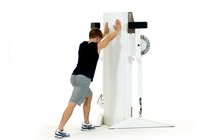
8.) Calf Stretch

- How: in a split stance, lunge towards a wall or post while keep the back leg straight and your heel flat.

- Why: The calf muscles get shortened and tight when we wear any type of heel. Yes, men’s shoes even have a heel. Also, many of us sit with our toes pointed and with our heel off the ground, further tightening the calf. This shortening can lead to ankle pain and major biomechanical issues when walking or exercising. These issues often lead to knee, hip, or lower back pain.