Friday, October 1, 2010

Should your Run?

Over the past 3 decades running has increased in popularity. Since 2005 Marathon running has increased by 83,000 'finishers' (IDEA Fitness Journal, Feb 2010). The topic of running as a way to get exercise has really been on my mind over the past few months. Many people feel that running is the only way to go. I have many clients that run, try to add running as part of their fitness regimen or are interested in training for a running event, such as a Marathon. Why is it that people feel they have to run consistently or over a certain distance? It is not that this is bad or not effective, I am just always curious why it is an all or none approach when it comes to running or jogging.

I would presume that most individuals work towards a certain time or distance goal or feel they have to run consistently because of traditional scheduled running events such as 5Ks, 10Ks, Half Marathons and Marathons. Often because of the persons competitive drive, ego or simply because of peer pressure needing to have a 'good' event time becomes a major goal. Therefore, you better run consistently (increase your mileage) and at a good pace. So basically consistently running without stopping or changing to another activity, in my opinion, developed because of the running events that are out there, and not necessarily because it was the 'best' way to get physical activity. Yet when I really get down to the nitty gritty of why most of my clients run or want to run it is because they feel it is one of the best ways to be physically active, stay fit and burn calories. I would completely agree that it is awesome to get outdoors, especially in San Diego, and that with running you don't need a gym or any equipment. Yet even though the need to run without slowing down your pace, walking , stopping or changing to another form of physical activity is necessary when training for a running event - it is absolutely not necessary or even ideal for most of your goals.

Not only is it not necessary to always run consistently over a certain time or distance it can be better for your body and mind to change your pace significantly or change to a different movement pattern at some point during the workout. For instance, one workout that I do weekly is a running based circuit through Balboa Park. The longest I may consistently run is for 10 minutes, but more often it is around 5 minutes. I might start by walking from my gym for about 5 minutes, then pick up the pace to a light jog for another 5 minutes. At this point I might stop at a park bench and do a set of Step Ups for a couple of minutes followed by Push Ups on the bench and then Jumping Jacks. Then back to walking for about 2-3 minutes followed by a faster jog this time until I find something new to do. Often this might be a flight of stairs that I will sprint up and down for a few minutes and then return to walking and jogging again.

The point of the explanation of my Balboa Park workout is to show you that yes you should be moving and elevating your heart rate, but you do not have to force yourself to run the entire time. If you are starting to fatigue then go ahead and walk. You have my permission, it's ok! Even better, and if you are in good running shape, at some point do something more intense than your typical walk or jog, such as increasing to a light sprint for 30-60 seconds or running stairs. This will force you to walk for a few minutes after the increase in activity. The best part about changing things up is that it changes the movement pattern of the body. This is excellent for maintaining functional/Multi-directional fitness and good joint range of motion. It also allows you to better avoid exercise related injuries from joint position overuse due to doing the same movement pattern (running over and over). Finally your body will not become accustomed to the same workout. When you do this you will always require an increased level of post exercise oxygen consumption. More simply put, there is a chance you will burn more total calories.

Many of you feel you can't run at all. "It is bad for my knees", you might say. And often yes you are correct, especially if you are still working through some movement and postural dysfunction. But remember it is not running that is necessarily the problem, it is your own movement dysfunctions, muscle imbalances and postural issues that make the impact of running 'not good' for you. For many, you might be surprised that picking up your feet a little bit and moving your walk into a 'trot' is totally fine. Especially for short bursts such as 1 to 2 minutes. Again, switch it up, do something different and don't let your mind and body get accustomed to the same thing over and over. Especially if you want to get better health, musculo-skeletal and calorie burning results.

Get outside, move your body and have fun. Always know which muscles on your body are consistently tight and stretch them first. Also activate any muscles that do not fire readily before you start the outdoor workout. If you are unsure of which muscles are tight on you and which muscles are not firing (activating) correctly then make sure to ask me.

So there, I said it. "You don't have to run!" You can use it or incorporate it with many other outdoor motions. And you are not a wimp if you don't want to run straight for 3 miles.

Finally, if you do enjoy your weekly runs you don't need to stop doing them - especially if you enjoy them. But remember, switch things up once in a while, you will avoid overuse injuries and often get better results.

Here is a more specific example of a good outdoor workout that is based around walking and jogging:

  • Walk for 5 minutes
  • Jog at an easy pace for 5 minutes
  • Walk for 2 minutes
  • Run or Walk stairs for 2 to 5 minutes if available
  • Do Jumping Jacks for 60 seconds
  • Walk for 2 to 4 minutes
  • Jog at an easy pace for 5 minutes
  • Accelerate your jog to a faster pace for 2 minutes
  • Walk for 2 minutes
  • Jog at an easy pace for 5 minutes
  • Accelerate your jog to a faster pace for 2 minutes
  • Walk and Cool Down for 5 minutes
Total Workout time: 40 minutes

Wednesday, July 7, 2010

Do You Have the Best Mattress?


Do You Have the Best Mattress?

A client of mine has started his quest for finding the right mattress. He suffers from occasional sciatica and has learned that the wrong mattress can bring about a sciatic ‘event’. He has tried standard coil with both latex and memory foam ‘top’ additions. The bottom line is he has yet to find the right formula or mattress. Being a client of mine has naturally made me take interest in his quest for researching the best solutions out there.

Sleeping and the surface or mattress we sleep on really does not get enough attention. If you think about it, we spend at least 7 hours a day sleeping. There are huge benefits with cognitive functioning, energy and even weight loss when it comes to a good night’s rest. Deep, high quality sleep is essential for good health and wellness. But also think about the effect on your body’s myofascial and skeletal system. Just like any other good or bad posture (standing or sitting) lying down and sleeping with poor alignment can affect the way your body moves and feels throughout the day. If your body is supported in a way that helps keep your joints in their ideal resting positions then you will move better and have little or no joint pain the next day.

So far, I have yet to find much research on mattresses, sleep quality and joint or muscle pain. Most of it is anecdotal. And a big part of the problem is that it is so individual.

Here is a summary of some of the major points out there to be aware of as well as a couple of studies that have been done.

The biggest challenge with mattresses is really giving them a solid test. Clete A. Kushida, MD, PhD, director of the Stanford Center for Human Sleep Research, says that you need at least 20 minutes on a mattress to even give it a fair test. Ideally he mentions that you should only buy from a store that allows a 30 day return policy. To me, this makes absolute sense. If you are going to spend 6 to 9 hours a night sleeping you better get it right.

There are a few main mattress categories:

1.) Coil: Still the standard, most people seem to be very comfortable with coil mattresses. The more coils the smaller they are and the more flexible and adjustable the mattress – even when still firm. Roger Herr, a spokesperson for the American Physical therapy Association, says they recommend a high coil mattress listed at 680 or above for most people. Although heavier individuals would do better with less, but larger coils, such as a listed 400 mattress. Less coils make them larger and stronger – but a lot less flexibility.

2.) Memory Foam and Latex: Both materials respond to body heat and ‘mold’ to your body. This can be a good or bad thing. If your alignment is naturally not good then ‘molding’ to it may not be a great thing – you are just reinforcing your postural problems. A firmer, less adapting, mattress normally helps to keep the spine and joints in a more neutral and straighter alignment. Again it comes done to personal comfort. One of the problems with synthetic materials is that they can increase body temperature and do not absorb sweat.

3.) Air Chambers: Sleep Number brand mattresses are an example. Although Kushida feels that air chambers are not the best overall choice they do leave a lot of versatility – especially for two people. If one of you feels better the next day with a firmer mattress you can increase the air and firmness of your side of the bed while the other can keep their side softer if they prefer. It is not good to have one person getting ideal sleep while the other suffers. So if this is the case you might want to look into a mattress that can adjust on each side. This is also why many hotels are moving to changeable air mattresses. They can allow their customers to find the right mattress.

So far I have yet to find any conclusions that hold for everyone, except that everyone should really take time trying out a mattress. Most researchers feel that the biggest thing comes down to personal preference and experimenting with different mattresses. Yes this can take time, but it is worth it. In general if they had to give one recommendation experts are still pointing towards a firmer mattress.

Here are two studies:

A study conducted at the Oklahoma State University showed that subjects felt much better the next day and had much less back pain when sleeping on a new, averaged priced coil mattress when compared to the same mattress that was 5 years or older. Seems kind of obvious, but the main point is that age has a huge affect on comfort and you might want to consider going mid range in price and upgrading every 5 years.

Another study done in Spain showed that of 313 subjects the consensus was not firm, but what is considered to be medium firm. They concluded that an overly firm mattress, though very supporting, may put too much pressure on the myofascial (muscular) system of the body. Yet again, they still found variation. Although not the average, some subjects preferred the way their body and back felt on a firmer mattress.

Tuesday, June 8, 2010

Why are the Feet and Ankles so important?

Just turn on the TV these days and you will see some type of commercial selling shoes or products that claim to do everything from relieve pain to tighten your butt. I'm not going to get into what may or may not be effective, but this highlights the fact that the feet and ankles are getting some good attention these days.

The feet and ankles, being our platform and the base of our support, have a huge influence on our body and the movement system within it. The foot makes the first contact to the ground, thus dictating how and where this force will be sent. In theory the foot is an amazing force transducer - at least when it is working correctly! Yet today's world of sedentary occupations and repetitive improper movements have led to any array of muscular-skeletal problems that can travel way beyond the foot and ankle themselves.

Common issues directly related to foot and ankle dysfunctions are, but not limited, to Low Back Pain, SI Joint Pain, Sciatica and Knee Pain.
Two of the most common dysfunctions with the foot and ankle complex are external rotation of the foot and ankle (foot turns out) when moving or squatting and eversion of the foot and ankle (Foot flattens) when moving or squatting. Both of these dysfunctions can often be corrected with exercise and flexibility techniques.

If you are not sure if you have eversion and external rotation just perform a squat test.

Overhead Squat Test:
1.) Stand with your feet shoulder width apart and pointing straight ahead
2.) Put your arms up and over your shoulders
3.) Slowly squat down as though you are going to sit into a chair
4.) Head back up to the starting position when your knees go just beyond 90 degrees.
5.) Observe what happens in your feet.

- If your feet turned out or flattened then you where positive for external rotation and eversion.

This is something that you do not want to ignore. If you do not have pain now, you will eventually have pain in the knee or lower back. Simple tasks like walking may not show up as a pain symptom of these dysfunctions. Yet do something more intense like a hike or workout and you might notice some issues with your knees, hips or low back. An old Exercise Science professor of mine used to say, " It is not a matter of if an injury will happen, but when".

There are many stretches and self massage techniques that can help with these dysfunctions, yet for now I will list three that you can easily use:

1.) Foam Roll the outer side of your calf:


2.) Foam Roll the outside of your shin:


3.) Stretch your calf while rotating the knee in and over the big toe:

Monday, May 17, 2010

8 Powerful Stretches to Counteract Computer Posture:

As I write this I am reminded how much I need these stretches! Most of us can’t live without at least some time on the computer and many of us have to be in front of them for the largest part of the work day. Unless you put your eyes in the back of your head there is no way to prevent the muscle shortening that happens when working on your computer. I don’t need to go into much detail, but most of you know the effects of poor posture and computer posture: neck pain, mid back pain, low back pain, headaches and many other wonderful issues. Bottom line: You have do something at least once/day to help lengthen the muscles that get tight and ‘beaten up’ from computer posture. Most of these stretches can be done right at your desk or office.

The following are my top 8 stretches to counteract computer posture:

(Remember to hold each stretch for at least 30 seconds and perform at least once/day)


1.) Trapezius/Neck Stretch


- How: Bring ear towards shoulder while tucking chin in.

- Why: The trapezius muscles get shortened from shoulder elevation and moving forward. When tight they can lead to neck, shoulder pain and tension headaches.


2.) Pectoral Stretch


- How: Grab a doorway, post, etc. Open chest and rotate away from arm.

- Why: The pectoral muscles get shorted from slouching and the shoulders moving forward. When tight they can lead to shoulder pain.


3.) Biceps Stretch


- How: Similar to the pectoral stretch, but keep arm straight at the elbow to emphasize the biceps.

- Why: The biceps muscles get shortened from the elbow being flexed during typing and moving your computer mouse. When tight they can lead to elbow pain.


4.) Abdominal Stretch

- How: Lying on a stability ball slowly bring your body back into spinal flexion. Exhale slowly as you hold the stretch.

- Why: The abdominals can get severely shortened from a rounded, slouching posture. When tight this puts stress on the spinal discs.


5.) Psoas Stretch

- How: Standing in a split stance, lunge slightly, tighten your glutes to tuck butt under and lift arm of stretch leg (back leg) overhead. You can add a lateral bend away to increase the stretch.

- Why: The Psoas muscle, like the abdominals, gets shortened from a slouched posture along with the fixed 90 degree angle of your trunk and leg when sitting. When tight it can put a lot of pressure on the spinal discs and lower back.

6.) Adductor/Inner Thigh Stretch

- How: Create a wide stance, lunge laterally bending the knee that is in the direction you are side lunging too. Keep the opposite leg straight.

- Why: The adductors, or inner thigh muscles, get chronically shortened when we sit. This can lead to internal rotation of your upper leg and possible knee or hip pain.


7.) Hamstrings Stretch

- How: Put one leg out in front of you and keep your knee straight, push your hips backwards while keeping your back straight to create stretch.

- Why: The Hamstrings muscles get shortened and tight from the fixed 90 degree angle at our knee when we are sitting. This can lead to over active hamstrings group and under active glutes. When this happens you are vulnerable to lower back pain, and many biomechanical issues when you walk and exercise such as ankle sprains and knee pain.

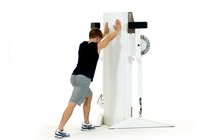
8.) Calf Stretch

- How: in a split stance, lunge towards a wall or post while keep the back leg straight and your heel flat.

- Why: The calf muscles get shortened and tight when we wear any type of heel. Yes, men’s shoes even have a heel. Also, many of us sit with our toes pointed and with our heel off the ground, further tightening the calf. This shortening can lead to ankle pain and major biomechanical issues when walking or exercising. These issues often lead to knee, hip, or lower back pain.